
It is said, “Until the lion learns to write, every story will glorify the hunter.” This profound truth set the tone for a momentous cultural exchange event held on August 19, 2025, at the National Museum of Kenya. Titled “Echoes of Peace,” the event commemorated 80 years since the end of World War II—a pivotal moment in world history that reminds us of the profound impact of war and the enduring importance of peace.
To mark this significant anniversary, the Chinese Media Group presented poignant films such as The Sinking of the Lisbon Maru and a special screening of Resistance on the Great Wall (The Sino-Japanese War). These films offered a window into the harrowing experiences of war survivors, including prisoner-of-war soldiers who endured drowning, starvation, or execution during World War II. The screening also explored the history of the China-Japan war, highlighting why the Great Wall of China remains a symbol of resistance and resilience. As the Chinese saying inspired by Mao Zedong’s poem goes, “He who has never been to the Great Wall is not a true man,” underscoring the courage of Chinese forces who, despite being underarmed, fiercely defended their homeland against the Japanese invasion in 1937.
The cultural exchange was attended by diplomats, including His Excellency Zhang Zhizhong from the Embassy of the People’s Republic of China to Kenya, academicians, media representatives, students, and history enthusiasts. In his remarks, His Excellency Zhang emphasized, “The past should not shape our future, but it informs us of what shouldn’t be repeated. This is why we emphasize dialogue instead of war, peace for all instead of conflict.”
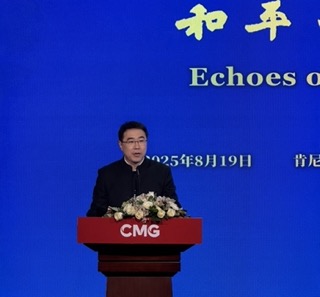
Highlighting the immense sacrifices of World War II, he noted, “Among the 60 million people who died worldwide, 18 million perished in China.” This somber reminder reinforced the devastating consequences of global conflict from 1918 to 1945—a period marked by profound suffering and destruction.
His Excellency Zhang further called for respect of the United Nations and the safeguarding of peace based on the UN Charter’s principles. “The principle of international justice must never be abandoned,” he stated.
Echoing these sentiments, Dr. Oscar Otele, Chairman of the Department of Political Science and Public Administration at the University of Nairobi, underscored the importance of upholding international law and justice. He noted that unity, peace, and national development are vital lessons derived from historical struggles, whether Kenya’s resistance against colonial rule, the China-Japan war, or the Nazi German war. “History shows us that despite aggression, victory is possible only through collective spirit and national solidarity,” he said.
Dr. Otele also urged honest engagement with history, cautioning against whitewashing or embellishing past events. “History shouldn’t be forgotten; it is not only a matter of justice but also a foundation for mutual understanding and reconciliation,” he asserted.
As the event concluded, Dr. Otele emphasized the need to move beyond zero-sum competition toward a shared future of cooperation and prosperity: “We should build a community of common destiny where countries, big or small, stand to benefit together in peace.”
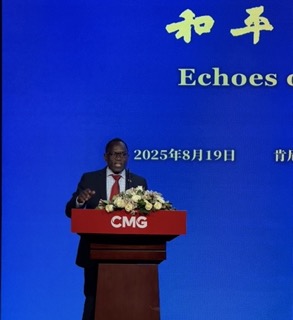
David Omwoyo from the Media Council of Kenya highlighted the crucial role of free expression and media in shaping society, as enshrined in Articles 33 and 34 of Kenya’s progressive Constitution (2010). “Culture is the soul of our people, and media is the voice of society. Culture lives through the stories we tell and the films we watch, demonstrating resilience and compassion even in times of war.” This reinforced the power of the media to capture pivotal historical moments, as exemplified by The Sinking of the Lisbon Maru, a powerful tribute to the forgotten heroes of World War II.

To close the event, students shared reflections on the importance of promoting peace over conflict. The phrase Hépíng, duì wǒmen Měi ge rén dōu yìyì zhòngdà! (Peace is of great significance to all people) resonated throughout the theater—a call to action and a constant reminder that peace should never be taken for granted.
May the echoes of peace continue to be heard in Kenya, China, and across the world, as we honor the legacy of World War II and recommit ourselves to a future free from the ravages of war.
 AfricanBlink